From the desk of Heather Gallant, 577 Executive Director
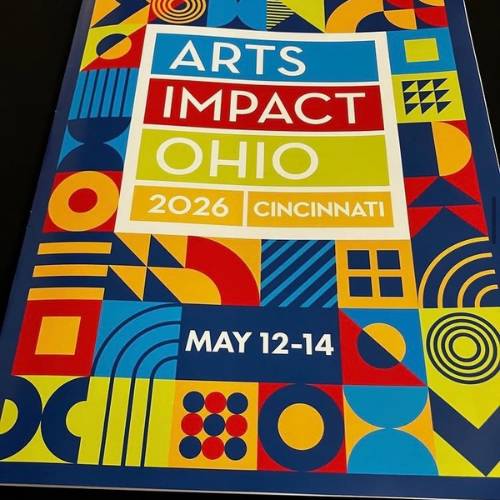
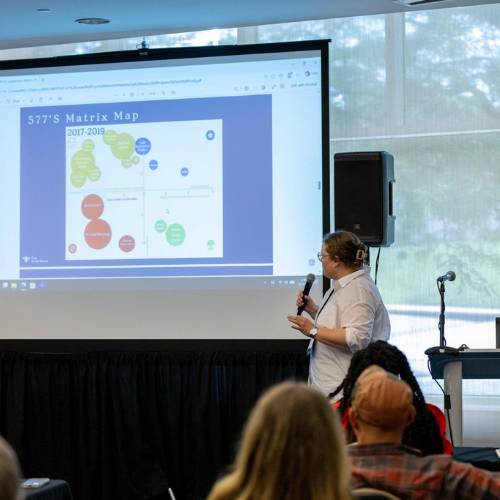
A few weeks ago, 577’s Assistant Director, Kelly, and I attended the Ohio Arts Council’s statewide Arts Impact Ohio conference in Cincinnati. We joined several hundred artists and arts-organization colleagues from across the state. On the final day, I presented on 577’s growth over the past few years and the factors behind it.
One of the keynote speakers was sidewalk chalk artist David Zinn. During the early days of the pandemic, his art inspired my children and me to visit parks and draw our own messages and creatures on the sidewalks. What a delight it was to finally meet him and learn about his artistic process!
Here are a few of David’s quotes and life lessons that reminded me of 577. Even outside the context of his speech, they resonate, and I wanted to share them with you:
- Meaningful art can be created quietly.
- Caring about what others think and feel is an important discovery.
- Ephemeral artists let things go. Preserving art is less rewarding than making it.
- If you do not have a plan for your art, technically you can never fail.
- Every day offers a chance to create something new from yesterday’s problems.
- Science is how we solve problems. Art is how we cope with them.
And my personal favorite: “More people making art in more places brings more joy to more people.”
In his talk and books, David describes how he confronted the “fear of the blank canvas” that many artists face and how he first became interested in art. While waiting in public, his parents would invite him and his brother to draw with pen and paper. When the blank page started to feel intimidating—when he worried about making mistakes or drawing less well than his brother—they invented a game called The Doodle Battle. Each person would scribble on a sheet of paper, trade pages, and then turn the scribble into a picture. Their battle cry was, “I bet you can’t make anything with that.”
In David’s words, “the standard changed from ‘make good art’ to ‘make art that is better than the scribble.’ In The Doodle Battle, the opponent is no longer the other person—or even the scribble. The opponent is the blank page. So everyone has already won.”
Many class participants tell us they fear the blank page when they begin a drawing or painting, the block of clay staring back at them, or that first cut into a piece of special fabric they have been saving. This is especially common for adults learning a new art form.
But as David pointed out, “Fear of the blank canvas is a manifestation of self-doubt.” It is not really about the blank canvas—or unmolded clay or untouched fabric. It is about feeling unskilled, doubting our abilities, or fearing the outcome, rather than enjoying the process of trying something new amid uncertainty.
One of my favorite quotes from 577’s founder, Virginia Secor Stranahan, is: “The pottery [studio] is not dedicated to the creation of great art, although great art would be welcomed should it happen.” I think Virginia recognized the difference between product and process: between a perfect finished piece and the experience of putting your hands in clay, finding joy in learning, and practicing something meaningful alongside other interesting people. From that perspective, the fear of the raw lump of clay fades. The pressure lifts. The goal is not to create great art—though we would gladly welcome it if it happens.
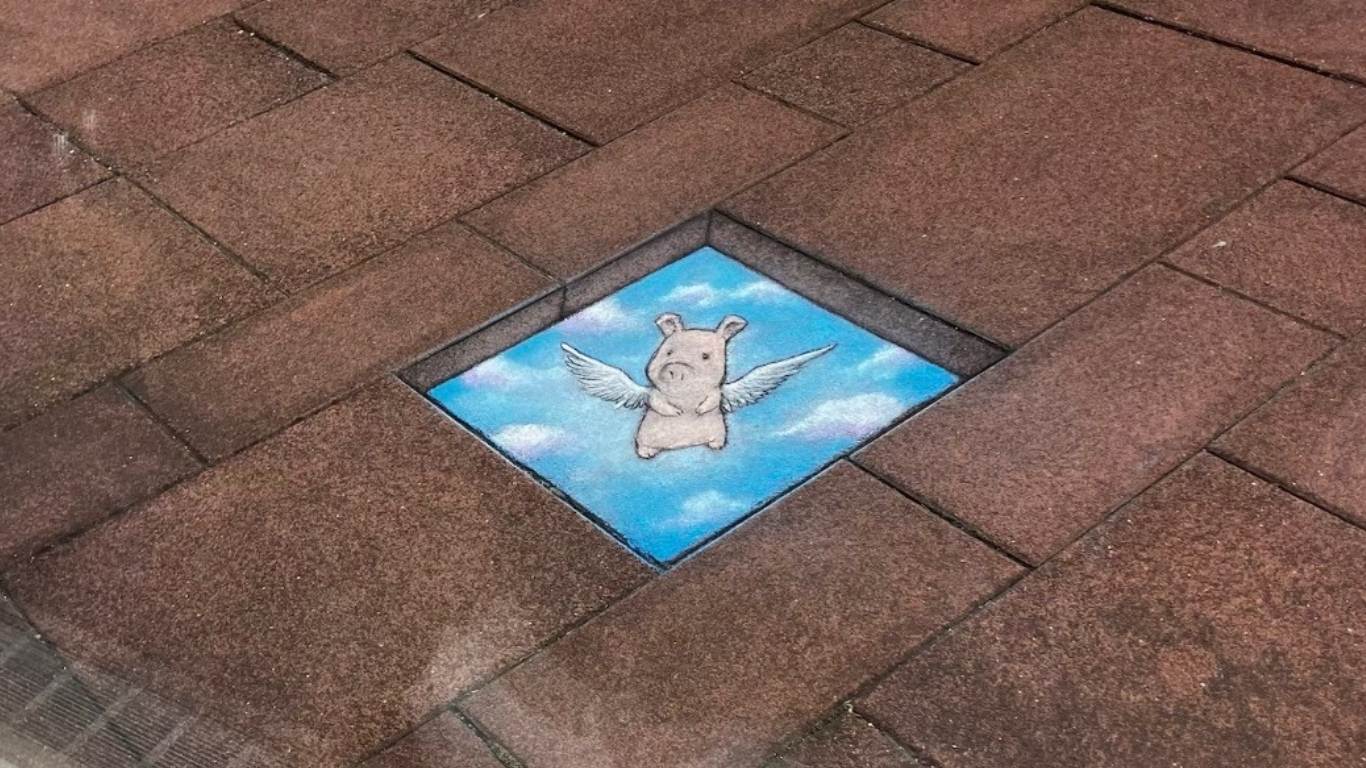
If you have a chance to explore David’s quirky, playful, heartfelt art, I think you’ll enjoy it. He improvises his pieces on the spot using chalk, charcoal, and found objects to enhance the landscape through a technique called ephemeral pareidolic anamorphosis:
- Ephemeral means fleeting, short-lived, and not here for long. After all, a sidewalk chalk piece lasts only until the next rainfall.
- Pareidolic refers to the human tendency to see patterns or features in something random—for example, noticing a face in a few spots on the concrete.
- Anamorphosis is a perspective technique that distorts an image so it looks very different depending on the viewer’s position. Because sidewalk art is typically viewed from above at an angle, David’s chalk drawings may look stretched or misshapen up close or from the side.
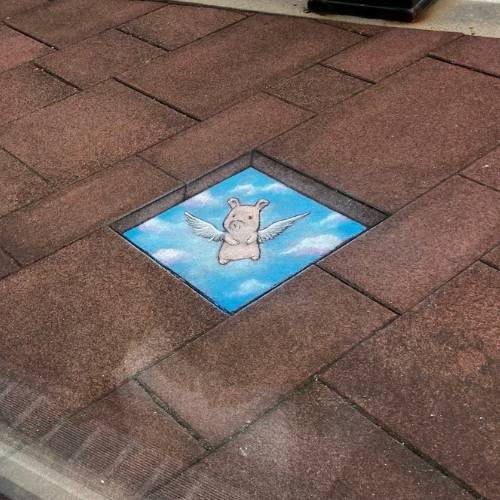
Using sidewalks as his canvas, David skips the blank canvas. He observes a spot and works with what’s there. Some days his old friends, his enduring characters, take center stage: Sluggo the cheeky green monster, Philomena the unflappable flying pig, or Nadine the audacious, curious mouse. Other days, a bear shows up, or a pair of rabbits in hats. Puppies, dragons, enigmatic sea creatures, birds, robots, and unidentifiable yet friendly beings full of personality who surprise and charm you just around the corner.
These little doses of joy remind me of spots around 577 – a face sculpture up in a tree, or a statue you weren’t expecting to see, or even plastic googly eyes that show up on the Courtyard’s basalt rock fountain from time to time. They remind me to find ways to make more of this magic for others to discover.
Will you join me in making art in more places to bring more joy to more people?
Take care,
Heather