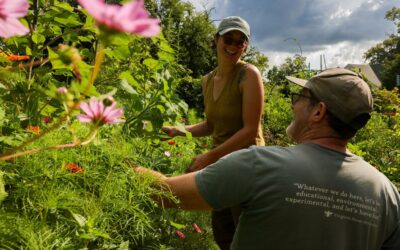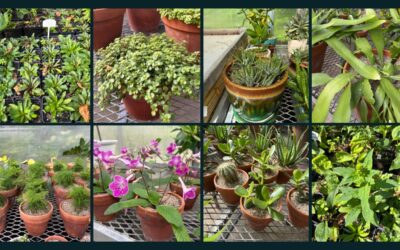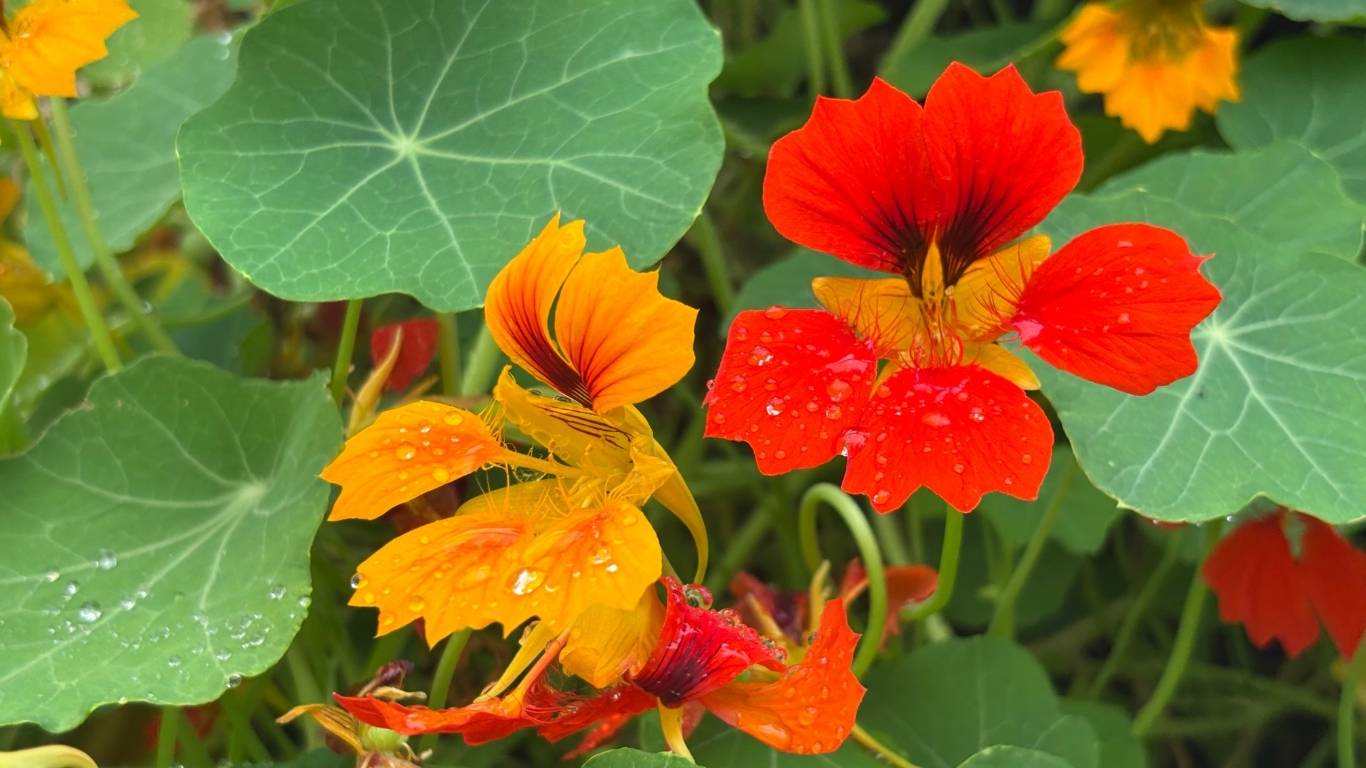
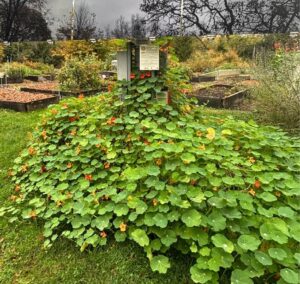
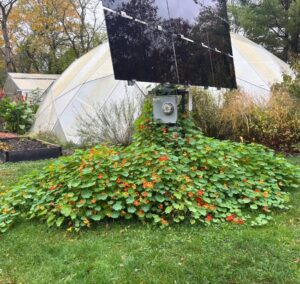
While walking toward the Geodesic Biodome recently, 577 staff spotted what looked like a mountain of greenery growing around the base of the solar panels. Upon closer inspection, tucked among all those round leaves were some pretty spectacular orange, yellow, and red blooms!
Naturally, we were curious. What was this sprawling plant, and how had it grown into such an impressive mound?
We turned to 577’s Organic Landscape Horticulturist, Bennett O. Dowling, who identified the plant as nasturtium and shared some interesting facts about its history, edible flowers, and how to grow it in your own garden.
A Closer Look at Nasturtium
By Bennett O. Dowling, Organic Landscape Horticulturist
Nasturtium (Tropaeolum majus and T. minus) is a useful and beautiful old-fashioned addition to the garden. Native to Central and South America, the nasturtium was brought back to Europe in the 16th century, where it was called ‘Indian cress’ due to its slightly spicy flavor that resembles watercress.
Nasturtium’s unique round leaves are a lush blue-green and the frilly flowers come in a range of colors from yellow to orange-red. Not only are the leaves and flowers ornamental, but they are also entirely edible, with a spicy, often peppery, flavor.
Even the large seeds can be pickled as a substitute for capers. When selecting nasturtiums for your garden, be sure to read about their growth habits; while Tropaeolum majus often vines up to 6 feet long or more, Tropaeolum minus has a tighter, clump-forming habit.
Whenever you are starting nasturtium, soak the seeds overnight in water before planting.
Either start indoors 4 weeks before the frost-free date or directly sow in the ground after the danger of frost has passed. When siting nasturtium in your garden, choose areas with full to part sun and well-draining soil.
Keep Exploring!
From its colorful, edible blooms to its impressive growth, nasturtium is a wonderful reminder that there’s always something interesting to discover in the gardens at 577.
The next time you’re exploring the grounds, take a closer look at the plants growing around you. You never know what might catch your eye!
577 is free and open to the public daily from 9 a.m. to 5 p.m.
577 East Front Street, Perrysburg, Ohio